PNL MEP Rareș Bogdan has become the first Romanian politician to publicly defend Nuclearelectrica’s investment in the small modular reactor (SMR) nuclear power plant at Doicești following the visit to Romania of Republican consultant Jason Miller, a close associate of Donald Trump. The liberal leader’s message comes at a time when the American-backed project is beginning to face criticism from within both the Romanian Government and the country’s energy sector.
The small modular reactor project at Doicești has entered an unprecedented phase of political and geopolitical confrontation in recent weeks. After interim Prime Minister Ilie Bolojan publicly criticized the costs and economic usefulness of the investment, and as increasing questions emerged within the energy sector regarding the viability of NuScale’s American technology, MEP Rareș Bogdan publicly stepped in to defend the project supported by the United States.
His position comes just days after the visit to Romania of Republican consultant Jason Miller, one of Donald Trump’s close associates and one of the most influential figures within the American conservative movement.
NewsCenter.ro contacted Rareș Bogdan to ask whether his public statement and position followed a possible meeting with Jason Miller during the latter’s visit to Romania. The PNL MEP initially replied that he did not know who Jason Miller was and that his post was unrelated to Miller’s visit.
“I do not know who Jason Miller is, I apologize. What I do know is that nuclear energy is becoming attractive again for Belgium, France, and Germany. I do not understand the effort to stop a key investment for Romania’s energy security,”
he wrote to NewsCenter.ro.
Rareș Bogdan: “The United States has strategic interests in the region”
In an extensive social media post, Rareș Bogdan described the Doicești project as “the flagship of the Romanian-American civil nuclear partnership” and warned that blocking the investment could create “a shockwave in diplomatic relations” between Bucharest and Washington.
The intervention by the liberal leader comes in a context in which, according to information published by NewsCenter.ro, Jason Miller promoted during his visit two strategic energy projects aligned with American interests: the SMR nuclear power plant at Doicești and the Vertical Corridor initiative for importing liquefied natural gas from Greece into Central Europe.
In his social media message, Rareș Bogdan explicitly defended the Doicești investment and warned of the diplomatic consequences that could result from Romania’s withdrawal from the project.
“The Doicești project, based on small modular reactor (SMR) technology, is the flagship of the Romanian-American civil nuclear partnership. The reversal we are witnessing is a geopolitical move of rare severity. The United States has strategic interests in the region. So do we, considering that we are neighbors of Russia,”
the PNL MEP wrote.
Rareș Bogdan compared Romania’s situation to that of Poland, which has significantly expanded its energy and defense partnerships with the United States in recent years.
“Poland has just massively strengthened its partnership with the United States for the construction of its first nuclear power plant. Warsaw delivers, while Bucharest is pulling the handbrake,”
he stated.
The liberal politician argued that the SMR project should not be viewed solely through the lens of economic profitability but also as a strategic security asset.
“Our energy security, our strategic protection, comes at a cost,”
Rareș Bogdan added.
Jason Miller and American energy projects
The MEP’s position comes after the discreet visit to Romania of Jason Miller, the Republican political consultant involved in Donald Trump’s electoral campaigns.
According to information previously published by NewsCenter.ro, Miller promoted during discussions in Bucharest two energy projects considered essential to the United States’ strategy in Eastern Europe: the SMR power plant at Doicești and the Vertical Corridor for transporting American liquefied natural gas unloaded at the Greek terminal of Alexandroupolis.
According to sources cited by the publication, the American consultant discussed these issues with individuals close to the presidential administration and with Romanian officials involved in the energy sector.
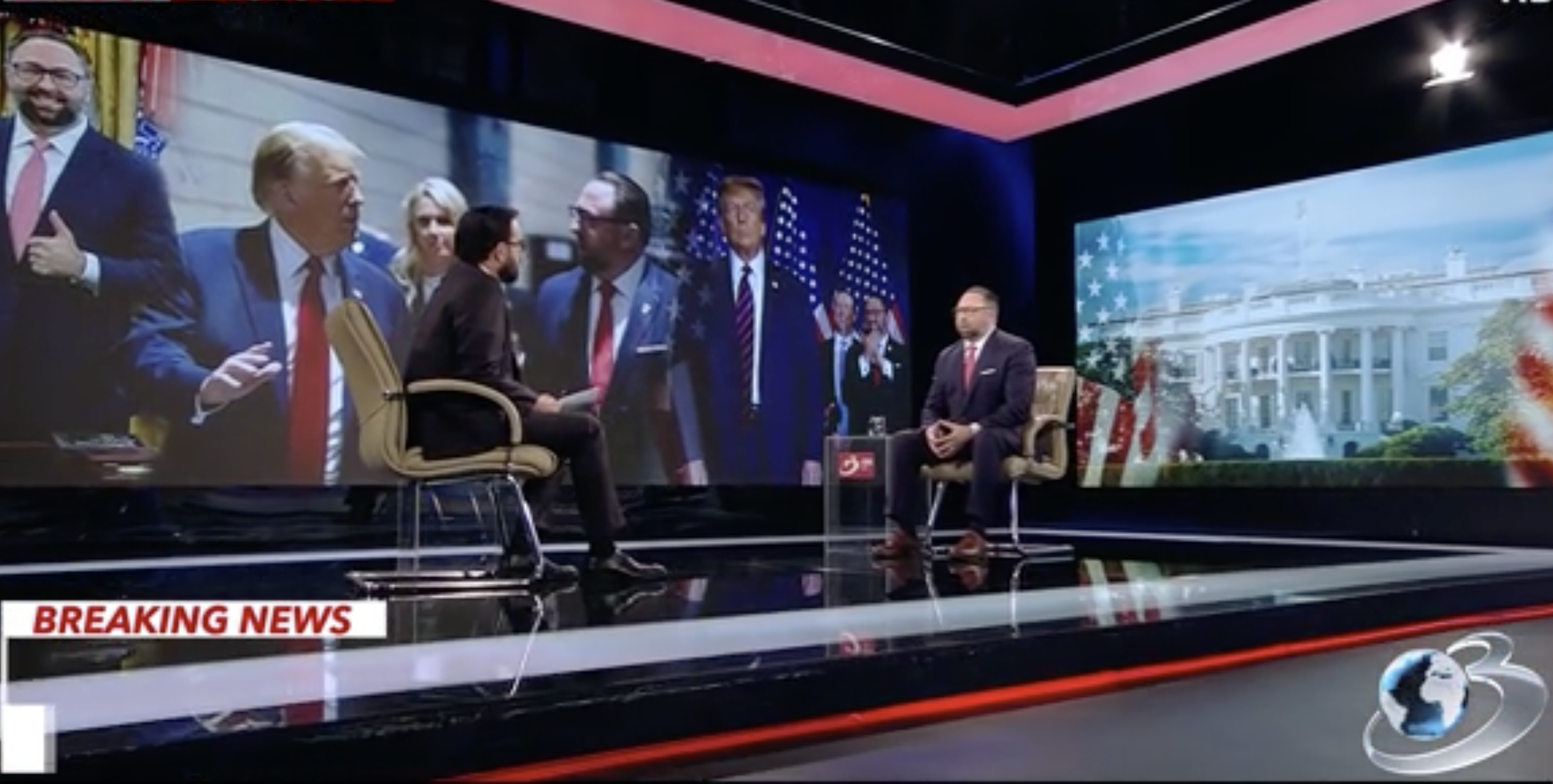
During his visit, Jason Miller also gave an interview to Antena 3, where he spoke about Romania’s strategic role in the region.
“Romania certainly has the opportunity to be one of the best allies in the entire region. I know it can become a very important point from both a military and energy security perspective,”
he said.
Miller also confirmed that he had met with President Nicușor Dan.
“I had the opportunity to meet President Dan and I was very impressed,”
the American consultant stated.
However, Nuclearelectrica clarified that its representatives had not met with Jason Miller.
“Representatives of Nuclearelectrica have not had such contacts,”
the company stated in a response.
Bolojan criticized the project
Rareș Bogdan’s intervention came after interim Prime Minister Ilie Bolojan became the first major political leader to publicly criticize the Doicești project.
In an interview with HotNews, Bolojan questioned the economic viability of the investment and highlighted the sums already spent.
“Do you know how much Nuclearelectrica has spent there? More than $240 million. We will be left with a piece of land and some paperwork. The question is: is it worth it?”
the interim prime minister said.
His remarks caused a major shock within the energy sector, where the project had enjoyed almost unanimous support in recent years.
The geopolitical stakes of the project
Rareș Bogdan insisted in his message that the Doicești project goes beyond its economic dimension and should be viewed as part of a broader American regional strategy.
“Romania as an energy hub is a project that began some time ago. It has many components, related plans, and projects that follow the same strategic axis,”
he explained.
The MEP also referred to the Constanța–Gdańsk corridor and other projects supported by the United States to strengthen NATO’s eastern flank.
In his view, Romania’s withdrawal from the SMR project would send a signal of political unpredictability to Washington.
“The costs of such radical decisions do not come in the form of direct invoices, but rather in the form of strategic cooling,”
Rareș Bogdan warned.
An investment worth more than €5 billion
The Doicești SMR power plant is being developed by RoPower Nuclear, a company equally owned by Nuclearelectrica and Nova Power & Gas.
The project is based on technology developed by the American company NuScale Power and is expected to become the first small modular reactor deployed in Europe.
According to technical data presented by Nuclearelectrica, the plant will have an installed capacity of 462 MW and could generate approximately 3.75–3.8 TWh of electricity annually, representing around 7.5% of Romania’s annual electricity production.
However, the estimated total costs exceed €5 billion, with some assessments placing the figure closer to $6 billion.
Critics argue that the investment is disproportionate relative to its generation capacity and warn that NuScale technology has not yet been deployed commercially anywhere in the world at full scale.
Comparisons with Bechtel
In recent months, the Doicești project has increasingly been compared to the famous Bechtel Highway project—an American strategic project that cost Romania billions of euros without ever being completed.
The Bechtel contract, signed in 2003 for the Transylvania Highway, envisioned the construction of more than 400 kilometers of motorway for approximately €2.2 billion. After nearly a decade, the Romanian state had paid more than €1.2 billion, while the American company had completed only about 52 kilometers.
Supporters of the SMR project argue, however, that just as in the Bechtel case, the real stake lies in strengthening the strategic relationship between Romania and the United States.
Rareș Bogdan appears to be conveying precisely this message: that the Doicești investment is not merely an energy project but a major test of the Romanian-American strategic partnership and of Romania’s positioning on NATO’s eastern flank.