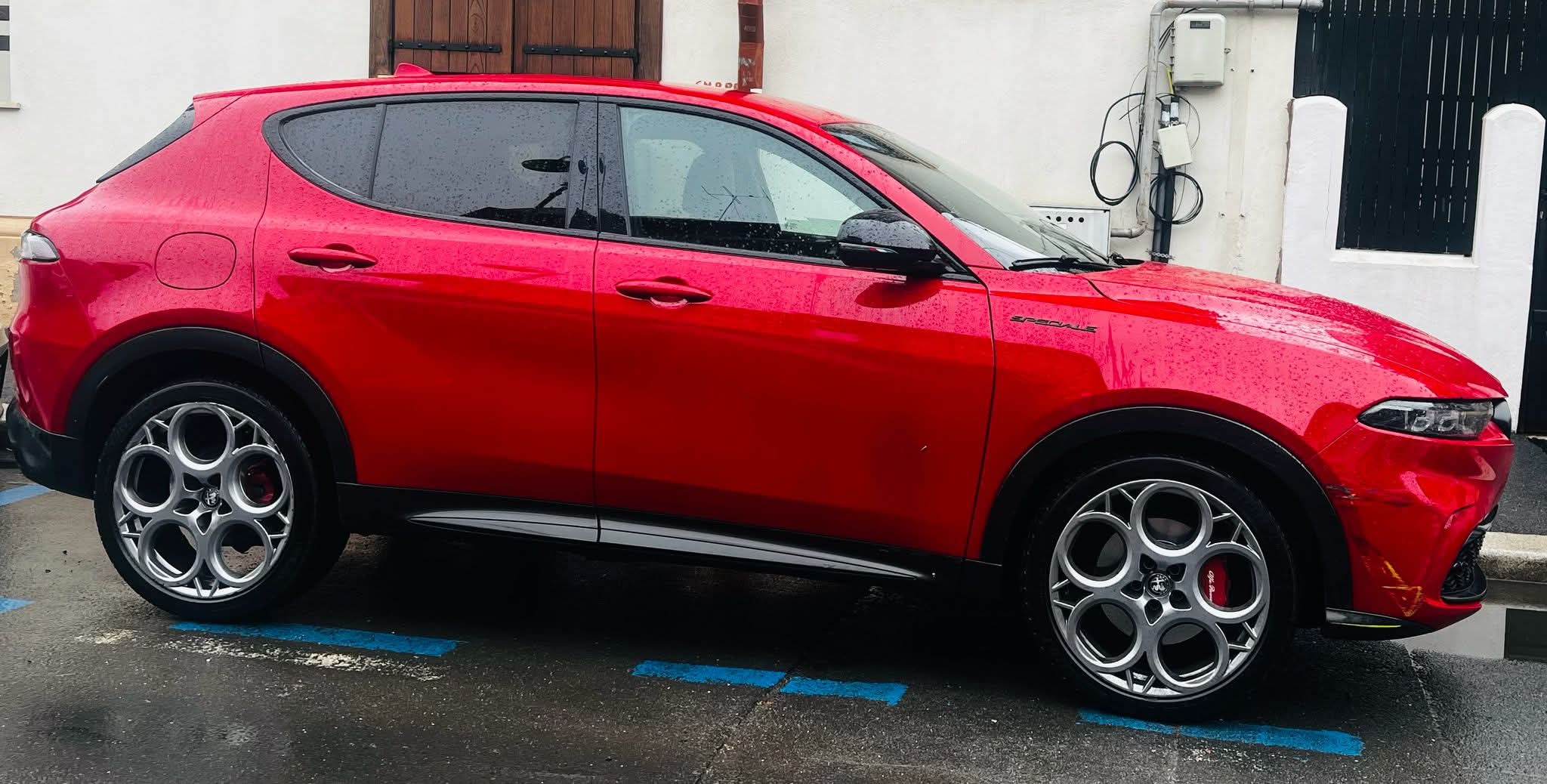
An Alfa Romeo Tonale hybrid that repeatedly malfunctioned, including breaking down on a railway crossing and putting the driver’s life at risk, has a factory defect in its timing system, according to an expert report commissioned by the vehicle’s owner. Because she has had to rent cars in order to avoid driving her own vehicle, and because it is frequently out of service, the woman has requested that the car be replaced.
Auto Italia, Alfa Romeo’s authorized dealer in Romania, refuses to replace the vehicle that allegedly endangers its owner’s life. The company benefits from the fact that the vehicle was purchased through a company and is therefore not covered by consumer protection legislation. Auto Italia declined to respond to our repeated requests regarding this case. The dealer informed the customer that it would repair the timing system free of charge as many times as necessary during the five-year warranty period.
Ramona purchased an Alfa Romeo Tonale from Auto Italia in 2022. She wanted a hybrid model and was attracted by this particular vehicle. Four years later, she says she can no longer use the car because it spends too much time in service and because she has become afraid to take the Alfa Romeo Tonale on long trips outside Bucharest. The technical issues affecting the vehicle purchased from Auto Italia have mainly involved the timing system. The car was purchased through leasing and serviced exclusively at authorized Alfa Romeo service centers.
The vehicle suddenly stopped on a railway crossing
“During the period in which I used the vehicle, it repeatedly experienced serious malfunctions consisting of the engine suddenly shutting down while driving, without prior warning and without any possibility of preventing the incident,” Ramona told us.
The first two incidents occurred in traffic on public roads.
“Each time, the engine shut down completely and the vehicle remained immobilized on the roadway. Although these incidents occurred on side streets, I had to block traffic until a tow truck arrived. In both situations, I experienced panic and insecurity, being exposed to the reactions of other road users and having no certainty that the vehicle would not cause an accident,” the woman recalls.
The most serious incident occurred at the entrance to the city of Arad, when the engine stopped near a railway crossing.
“At that moment I was in the vehicle together with my child. The malfunction occurred suddenly, and the vehicle was left unable to move in a place where any delay or inability to clear the roadway could have had extremely serious consequences,” Ramona said.
“I experienced intense fear and anxiety, generated both by the risk to my life and my child’s life and by the danger created for other road users. At that moment, my main thought was that if the situation worsened or if a train or other vehicles appeared that could not avoid the obstacle, the consequences could be dramatic,” she added.
The driver no longer trusts the vehicle’s safety
These incidents were not simple technical inconveniences but situations that created a real risk to road safety and to the people inside the vehicle.
“The fact that the engine stopped unexpectedly during normal use made me lose confidence in the vehicle’s safety and live with the constant fear that another shutdown could occur at any moment, in an even more dangerous location,” Ramona says.
“I believe such malfunctions endanger not only the occupants of the vehicle but also other road users through roadway blockages, loss of vehicle maneuverability, and the risk of serious accidents.”
NewsCenter.ro repeatedly sought a position from Auto Italia regarding such incidents. No response was received.
The company also benefits from the fact that the vehicle was purchased through a company, meaning that consumer protection legislation does not apply. This was confirmed by representatives of the Consumers Protection Association (APC).
“Vehicles purchased by companies do not benefit from consumer protection legislation. In such situations, the company can resort to mediation or legal action,” the specialists explained.
Three service interventions for the same issue in less than 50,000 kilometers
Because she can defend her rights only through a court decision, Ramona commissioned an independent technical expert report on the vehicle purchased from Auto Italia. The car examined was an Alfa Romeo Tonale equipped with a 1,469 cc, 130-horsepower gasoline hybrid engine.
In the technical report completed in April 2026, the expert identified serious defects in the engine timing system. According to the expert, the defect appeared three times in less than 50,000 kilometers and may directly endanger road safety.
According to the report prepared by automotive technical expert Ioan Onciu, the first serious issue occurred in May 2024 at only 26,703 kilometers, when the entire timing kit had to be replaced.
Just over a year later, in July 2025, at 42,445 kilometers, the same problem reappeared and the timing kit had to be replaced again.
In April 2026, at only 48,568 kilometers, the vehicle once again began displaying dashboard errors and the engine started running irregularly. The report notes that the engine shut down while the car was crossing a railway line in the city of Arad.
After the vehicle was transported to an authorized Alfa Romeo service center in Arad, mechanics performed electronic tests and partially dismantled the engine. They concluded that one of the camshafts was no longer properly synchronized with the crankshaft.
“This malfunction affects the engine timing system, meaning the synchronization between pistons and valves. Normally, the system must operate with extremely high precision. If synchronization is lost, the engine may run erratically, lose power, or stop completely while driving. In severe cases, internal engine damage may occur,” the report states.
“The problem is not an isolated one”
The report concludes that:
“The problem does not appear to be isolated or caused by poor maintenance. On the contrary, the vehicle was serviced according to the manufacturer’s recommendations, and the timing system was replaced twice under warranty.”
However, the expert believes that the most likely cause is a design defect in the timing system itself.
The arguments cited include: the timing system failed three times before 50,000 km; the timing kit had already been replaced twice; there are numerous similar interventions on Alfa Romeo Tonale models; and the model’s relatively short production period suggests the existence of technical issues implicitly acknowledged by the manufacturer.
“Under normal circumstances, a modern timing chain system should function without major issues for hundreds of thousands of kilometers. Repeated failures before 50,000 km are considered unusual even for a heavily used engine,” the report further states.
The most serious conclusion concerns road safety. The expert explicitly states that the defect:
“poses a risk to road safety,”
because the engine may run irregularly and stop unexpectedly while driving, something Ramona says she has already experienced several times.
Such a sudden shutdown can become critical in multiple situations: during overtaking maneuvers, on highways, at intersections, while crossing railway tracks, or in heavy traffic.
Loss of engine power also affects power steering and the effectiveness of auxiliary systems, reducing control over the vehicle.
The report further notes that the Alfa Romeo Tonale equipped with this engine was produced over a relatively short period, between 2022 and 2025, and suggests that this limited production run may indicate structural technical issues with the platform or powertrain.
Even Auto Italia mechanics acknowledge the widespread issue affecting the Alfa Romeo Tonale
Because Auto Italia refused to provide an official position on this case and on other similar situations, if any, we reviewed conversations between Ramona and mechanics at the company’s authorized service centers.
In one exchange, a mechanic acknowledged that:
“the problem occurs at relatively short intervals.”
The owner stated that she had replaced the timing kit three times, including under warranty, with the latest intervention taking place in July 2025 and the defect reappearing in April 2026. The service representative confirmed that such situations are common:
“Unfortunately, the interval I keep noticing is somewhere around 15,000 km,”
and in this particular case the issue reappeared after only about 5,000 km.
The most important statement in the conversation came when the mechanic described the issue as:
“a design defect,”
while adding that:
“it has not yet been determined whether it is officially considered a manufacturing defect.”
The same representative admitted that the issue is:
“common on the hybrid version”
and that there are:
“enough vehicles with similar situations,”
suggesting that the defect may be repetitive and systemic.
The conversation also revealed that the manufacturer:
“has not come up with anything to improve it,”
and that only:
“a component on the tensioner”
has been used to:
“slightly extend the life”
of the assembly.
The service representative also stated that repairs are carried out:
“either under warranty or at the customer’s expense,”
without the existence of a definitive technical solution.
When should a vehicle under warranty be replaced because of serious technical defects?
Romanian and European legislation provides that an automotive dealer may be required to repair, replace, or even refund the value of a vehicle under warranty if it suffers from serious or repeated defects.
According to Government Emergency Ordinance No. 140/2021 on the sale of goods, consumers may request replacement of a vehicle when it cannot be brought into conformity through repairs within a reasonable period or when defects repeatedly occur and affect the vehicle’s normal use and safety.
In cases involving technical defects that may endanger the lives of the driver or passengers—such as failures of the braking system, steering system, engine, or unexpected shutdowns while driving—the dealer is obligated to remedy the situation promptly. If repairs fail to resolve the problem, the customer may request replacement of the vehicle or termination of the contract with a refund. The law protects consumers when defects repeatedly occur during the warranty period and the vehicle cannot be safely operated.
The National Authority for Consumer Protection has not yet responded with information regarding complaints filed by Romanians concerning vehicles purchased under warranty that suffer from serious technical defects and cannot be safely driven. NewsCenter.ro also asked how the authority intervenes in such situations.