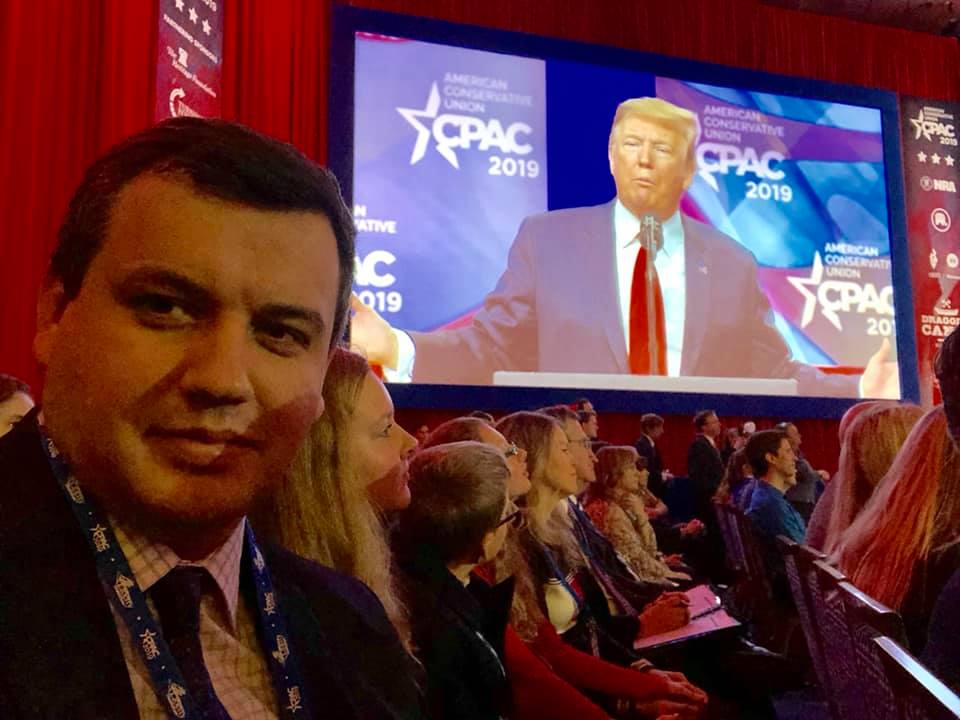
Appointed prime minister-designate by President Nicușor Dan, Eugen Tomac completes an almost perfect circle in a career built in close proximity to the power center at Cotroceni Palace. He began as an expert within the Presidential Administration at the age of 26, serving under Traian Băsescu.
He rose through political parties and positions in the former president’s orbit. He survived politically after Băsescu’s decline, remaining anchored in the People’s Movement Party (PMP). And in 2025, he returned to Cotroceni, this time as Nicușor Dan’s adviser on Diaspora affairs — the very space in which Călin Georgescu and AUR built their political rise. In Romanian politics, Eugen Tomac is, above all, a president’s man. He has worked for two of Romania’s last three heads of state.
Beyond his ties to two of Romania’s last three presidents, Tomac’s career reveals another detail. Every time he entered a sensitive position within the Romanian state, he passed through the filters of the intelligence services.
Tomac’s rise was always under the scrutiny of the SRI and SIE
In other words, his political and administrative ascent was consistently vetted by the Romanian Intelligence Service (SRI) and the Foreign Intelligence Service (SIE).
This is an institutional requirement.
Anyone working within the Presidential Administration or the President’s Chancellery undergoes vetting procedures for access to classified information. Similarly, individuals holding positions with an international dimension or managing relations with Romanians abroad are subject to specific clearance procedures.
Tomac passed through all these stages: expert at Cotroceni beginning in 2006, Secretary of State for Romanians Abroad in 2009, and State Counselor within the Presidential Chancellery in 2012.
Three entries into state structures with access to classified information, three rounds of security screening. The fact that he successfully passed all these filters — under Băsescu, under different governments, and now under Nicușor Dan — means that the competent institutions identified no reason preventing him from holding these positions.
On Putin’s blacklist since 2015
His inclusion on Russia’s blacklist in 2015, alongside MI5 and MI6 directors, intelligence chiefs from Poland and Estonia, and military commanders from across Europe, adds another layer of complexity. Moscow considered him sufficiently troublesome to ban him from entering the Russian Federation.
For the Kremlin, his activities in the Republic of Moldova, support for projects aimed at Romanians living abroad, and promotion of Romanian identity in the former Soviet space amounted to actions hostile to Russian interests. Whether this made him a collaborator of Romanian intelligence services or simply a politician viewed as inconvenient by Moscow remains a question without a public answer.
In 2015, Russia placed Eugen Tomac on a list of 89 European officials banned from entering Russian territory, alongside former British intelligence chiefs, defense ministers, and other officials accused by Moscow of engaging in “anti-Russian activities.”
The Kremlin justified the ban by citing “anti-Russian activities,” a formulation broad enough to encompass almost any project carried out in Moldova or Ukraine with Romanian institutional support. This does not mean Tomac was an intelligence officer, but it does show that Moscow considered his activities sensitive enough to place him on the same list as Western intelligence chiefs. Several Romanians appeared on that list, whose composition is detailed at the end of this article.
The Romanians included were:
Iulian Chifu, former adviser to the Romanian Presidency on strategic and national security issues;
Tiberiu-Liviu Chondon, commander of the Romanian Naval Forces Fleet;
Adrian Cioroianu, former vice-president of the ALDE Group in the European Parliament, historian and professor at the University of Bucharest;
Gheorghe Hațegan, deputy general director of Transgaz;
and Eugen Tomac, president of the People’s Movement Party (PMP).
The Bessarabian who grew up politically at Cotroceni
Eugen Tomac was born on June 27, 1981, in the village of Babele (Ozerne), in southern Bessarabia, today part of Ukraine’s Izmail region. He came to Romania at the age of 17 through a Romanian government scholarship program, a biographical detail that would shape his entire political trajectory: the issue of Romanians abroad became not only a career theme but also part of his own life story.
He studied History at the University of Bucharest, obtaining his bachelor’s degree in 2003 and a master’s degree in 2005, both focused on Bessarabia and Soviet-era denationalization policies.
He began doctoral studies at the university’s Doctoral School of History in 2006, although his academic path gradually took a back seat as his political career accelerated.
As early as 2000, before turning 20, he co-founded the League of Young Romanians Abroad, which he led until 2004. He later co-founded the Center for Democratic Education in 2005.
These civil society organizations became his launching pad into state power structures.
In 2006, at only 26 years old, Tomac joined the Presidential Administration as an expert responsible for relations with Romanians abroad. It marked the beginning of his relationship with Cotroceni Palace and, more importantly, with Traian Băsescu, then serving his first presidential term.
This was more than just a job. It was his entry into the inner circle of the most influential politician in Romania at the time.
“Băsescu’s man”: from Cotroceni to the PDL and back
Traian Băsescu was Eugen Tomac’s political mentor. This observation has been repeated frequently in the Romanian press. Tomac climbed step by step through the administrative and political hierarchy of the Băsescu era, with each stage of his career coinciding with a promotion or a new position.
Between 2007 and 2008, he worked as an assistant at the “Eudoxiu Hurmuzachi” Institute for Romanians Abroad. In 2008, he joined the Democratic Liberal Party (PDL), the party backed by Traian Băsescu, and began his genuine political rise.
In 2009, he was appointed Secretary of State for Romanians Abroad within the Ministry of Foreign Affairs, a position he held until 2010. Between 2010 and 2012, he advanced to Secretary of State within the Department for Romanians Abroad under the Romanian Government.
His highest-ranking position during the Băsescu era came in 2012, when he was appointed State Counselor within the Presidential Administration. Tomac thus returned to Cotroceni, this time not as a junior expert but as a trusted figure within the presidency’s top structure.
In December 2012, he ran on behalf of the PDL-ARD alliance and won a seat in Parliament representing Constituency 43 Diaspora, which also included the Republic of Moldova. He chaired the Parliamentary Committee for Romanian Communities Abroad between 2012 and 2013.
Tomac’s political life and the issue of Romanians living outside the country were essentially two sides of the same coin.
However, internal tensions within the PDL led to a split in 2013. Tomac resigned from the party and joined the People’s Movement Party (PMP), the new political formation built around Traian Băsescu. Within PMP, Tomac remained one of Băsescu’s closest collaborators.
He was also Elena Udrea’s ally, and she praised his nomination as prime minister
The creation of PMP, the party founded by Traian Băsescu after leaving office, involved three central figures: Traian Băsescu, Elena Udrea, and Eugen Tomac.
Elena Udrea, former minister and one of the most influential figures in Băsescu’s inner circle during his presidential mandates, took over PMP’s leadership in June 2014 at the party congress. Until then, Tomac had served as interim leader and remained vice-president responsible for relations with Romanians abroad.
Tomac also supported Udrea during the 2014 presidential campaign when she ran for the presidency. It was a deliberate political choice at a time when Udrea had already become one of the most controversial figures in Romanian politics.
In 2015, after Elena Udrea stepped down from the party leadership, Eugen Tomac became PMP president for the first time. Udrea would later be convicted in corruption cases and serve part of her prison sentence, but the political relationship between the two remains part of Tomac’s public biography.
Following Tomac’s nomination for prime minister, Elena Udrea reacted favorably, describing him as “one of the closest collaborators” she had during the PMP years.
The former minister stated that Tomac is “someone you can rely on, constructive, relatively discreet, serious, and possessing far more common sense than most politicians.” Although she believes Romania would have benefited from a prime minister with a stronger economic profile, Udrea argued that Tomac’s nomination represents a compromise solution capable of “solving everyone’s problems” in the current political deadlock.
Member of the European Parliament during Iohannis’s second term
In July 2019, Eugen Tomac became a Member of the European Parliament after being elected on the PMP list. That same year, Klaus Iohannis won a second presidential term, while the political stability imposed by the PNL and PSD dominated state appointments. The two parties were already discussing plans to govern together until 2030.
During his first term in the European Parliament, Tomac sat with the European People’s Party (EPP), the main center-right political family in the European Union.
In 2024, he secured a second mandate as an MEP, this time through the United Right Alliance, formed by USR, PMP, and Forța Dreptei. This new political formula also brought an important change in parliamentary affiliation. Tomac moved from the EPP to the Renew Europe group, alongside USR’s Members of the European Parliament.
In Brussels, he focused primarily on issues related to the Romanian diaspora, the Republic of Moldova, EU enlargement, and relations with countries in the Eastern Partnership.
Many observers interpreted the change of parliamentary group as an ideological repositioning, moving from the conservative orientation of the EPP toward the liberal and reformist platform represented by Renew Europe.
At the same time, his position as a Member of the European Parliament creates a legal issue if he is confirmed as prime minister. Under Romanian law and European regulations: “The office of Member of the European Parliament shall be incompatible with that of member of a government of a Member State.”
Therefore, if he secures a parliamentary vote of confidence, Tomac will be required to resign from his European Parliament mandate.
Back to Cotroceni: Nicușor Dan’s adviser on the electorate that fueled Călin Georgescu’s rise
In October 2025, President Nicușor Dan appointed Eugen Tomac as honorary adviser for relations with Romanians abroad within the Department for Foreign Policy, Strategic Partnerships, and Romanians Abroad of the Presidential Administration.
Symbolically, it was a return home. Tomac had first entered Cotroceni Palace in 2006 as an expert in Traian Băsescu’s team. Nearly two decades later, he returned to the same institution, but alongside a president with a completely different biography and political style.
Nicușor Dan, a former civic activist, mathematician, and founder of the Save Bucharest Union movement, represents almost the opposite of Traian Băsescu in terms of political style. Yet both presidents chose to bring Eugen Tomac close to the center of power.
The explanation appears to lie in Tomac’s specialization in diaspora affairs and Romanian communities abroad. Over nearly twenty years of public activity, he accumulated relationships, experience, and expertise in a field where few Romanian politicians have remained consistently active.
Moreover, the Romanian diaspora was the political space in which the phenomenon surrounding Călin Georgescu emerged and expanded. Georgescu, who won the first round of the 2024 presidential election before the vote was annulled by the Constitutional Court, built much of his support among Romanians living abroad.
From presidential adviser to prime minister-designate: the nearly impossible mission of securing 233 votes
The announcement of Tomac’s nomination was made at Cotroceni Palace after weeks of difficult negotiations among parliamentary parties and following the collapse of the government led by Ilie Bolojan.
President Nicușor Dan justified his choice by arguing that Romania needed a figure who would not be perceived as the direct representative of a political party and who could potentially build a parliamentary majority in an extremely fragmented legislature.
Immediately after his nomination, Tomac submitted his resignation from the leadership positions he held within the PMP, seeking to send a message of political neutrality and distance from partisan structures. He also stated that he intends to propose a technocratic government and build an executive capable of obtaining parliamentary support beyond traditional party lines.
Yet Tomac’s designation does not solve the central problem.
To actually become Prime Minister of Romania, he must win a vote of confidence in Parliament. Under the current political configuration, a government requires 233 votes to secure parliamentary approval.
That means Tomac must effectively construct a governing majority almost from scratch.
The portrait of a system insider
Viewed as a whole, Eugen Tomac’s career reveals a politician who has managed to remain close to centers of power without becoming a major source of political conflict himself.
Over more than two decades in public life, he has not triggered dramatic political ruptures, built rival factions, or become associated with scandals on the scale that have defined the careers of many other Romanian political leaders.
Instead, he built his profile around a specific theme: Romanians living abroad and Romania’s relationship with the Republic of Moldova.
That specialization allowed him to survive multiple political eras without losing relevance.
He was Traian Băsescu’s man. He worked alongside Elena Udrea within the PMP. He survived the decline of that political party. He later joined Nicușor Dan’s presidential team. Few Romanian politicians can claim to have navigated so many political transformations without disappearing from the public stage.
For that reason, Eugen Tomac’s profile is closer to that of a system insider than that of a political revolutionary.
He is a politician who appears to have understood that influence is not always achieved through confrontation. Sometimes it is achieved through continuity, loyalty, and the ability to remain useful regardless of who occupies the presidential office at Cotroceni.
If he succeeds in obtaining Parliament’s vote of confidence and becomes Prime Minister, Eugen Tomac will, for the first time, move beyond the role of adviser, collaborator, or protégé of more powerful political figures.
He will become the person directly responsible for governing Romania.
And for the first time in his career, success or failure will no longer be attributed to Traian Băsescu, Elena Udrea, or Nicușor Dan.
They will belong exclusively to Eugen Tomac.