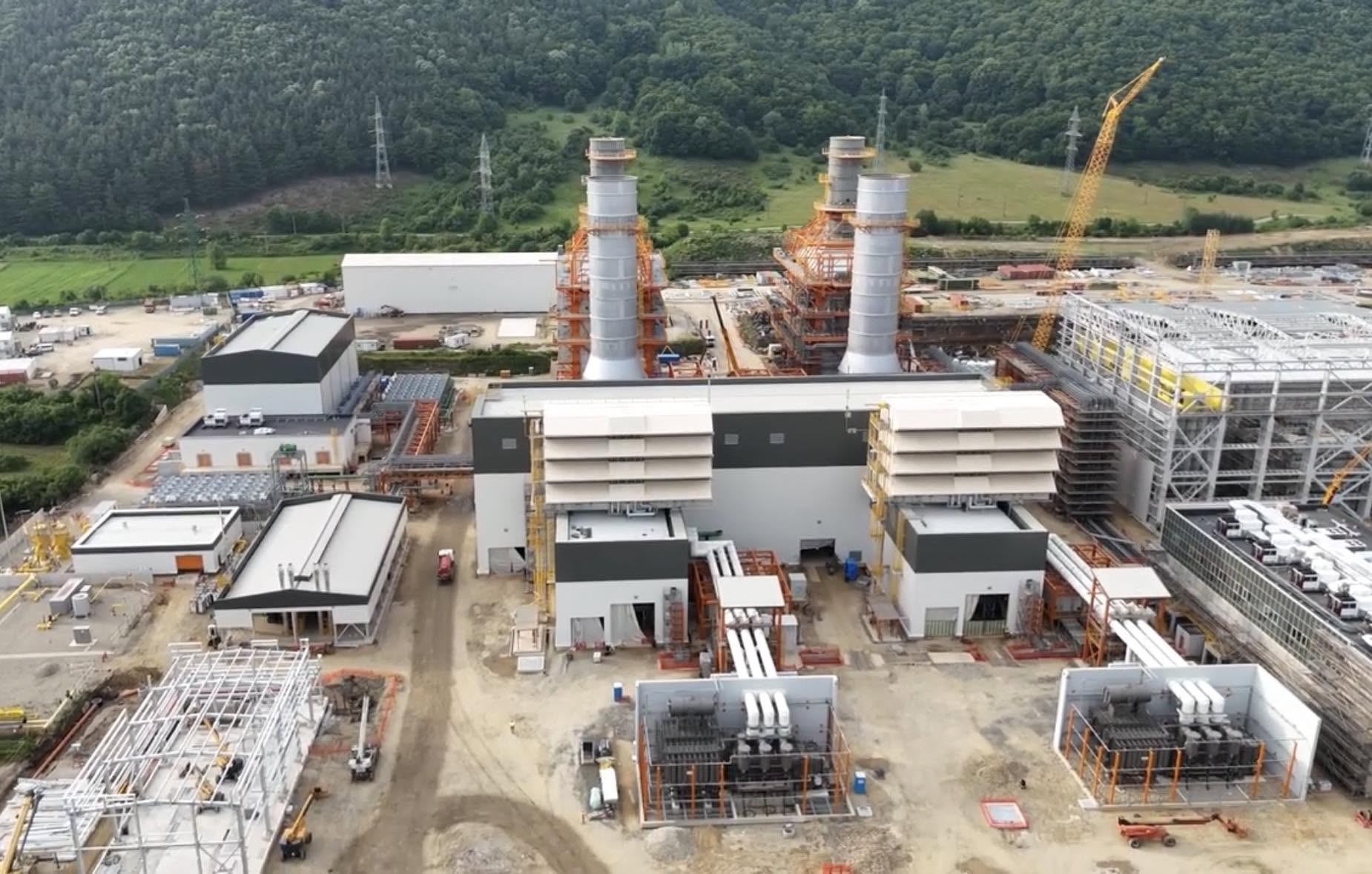
In fact, the Mintia power plant could consume nearly half of the natural gas used directly and indirectly by Romania’s population. Direct residential gas consumption amounts to approximately 3.5 billion cubic meters per year, while another 2 billion cubic meters of gas are required to generate the electricity consumed by households.
The Black Sea gas solution may last only a decade
Looking ahead, in order to operate at a high capacity factor, the Mintia power plant will require at least 2 billion cubic meters of natural gas annually. This gas will have to come either from imports or from the Neptun Deep offshore field, which is being developed by OMV Petrom and Romgaz in the Black Sea.
At first glance, Black Sea gas appears to offer a solution.
However, there are important limitations. The Neptun Deep field is estimated to contain approximately 100 billion cubic meters of recoverable natural gas over its lifetime, while annual production is expected to reach a maximum of around 8 billion cubic meters for a period of 10 to 12 years.
These 8 billion cubic meters of annual production will not simply be added to Romania’s current domestic output of roughly 9 billion cubic meters per year. This is because production from the country’s existing gas fields is steadily declining.
According to projections used in Transgaz’s strategic planning documents, Romania’s conventional natural gas production could fall to approximately 6-7 billion cubic meters annually by 2035 unless new large-scale fields such as Neptun Deep are brought into operation.

“According to the estimates used by Transgaz in Romania’s 2025–2035 Energy Strategy, the country’s conventional natural gas production is expected to decline to approximately 6–7 billion cubic meters per year by 2035 unless major new fields such as Neptun Deep in the Black Sea are brought into production,” the company’s documents state.
As a result, the estimated annual production of 8 billion cubic meters from the Neptun Deep project would likely be allocated to cover:
- approximately 2 billion cubic meters to offset declining production from existing gas fields;
- approximately 1 billion cubic meters for the Azomureș fertilizer plant, should Romgaz complete and obtain regulatory approval for its planned acquisition;
- approximately 1 billion cubic meters that OMV Petrom has committed to supply under agreements with Uniper and Energocom;
- approximately 600 million cubic meters for the Iernut gas-fired power plant;
- approximately 2 billion cubic meters for the Mintia power plant;
- approximately 1.8 billion cubic meters for the gas-fired projects of the Oltenia Energy Complex, provided those projects are completed.
Consequently, while annual gas production from the Black Sea could reach approximately 8 billion cubic meters, the combined demand generated by these projects and contractual commitments could exceed 8.4 billion cubic meters per year.

Relative to the projected output of the Neptun Deep project, the Mintia power plant could consume between 25% and 30% of the natural gas extracted annually from the Black Sea. In other words, roughly one out of every four cubic meters produced by Neptun Deep could end up at Mintia for electricity generation.
Gas consumption of Romania’s major planned power plants: approximately 3.5 billion cubic meters per year
In addition to the Mintia project, there are four other major gas-fired power plants that still have a realistic chance of being completed.
At Iernut, Romgaz is attempting to finalize a project that began in 2017 and has been delayed by nearly seven years. The 430 MW power plant is more than 95% complete, and the company estimates that commissioning will take place by the end of 2026.
In Oltenia, the situation is more complicated. The 850 MW Ișalnița power plant has been stalled after two consecutive tenders failed to attract bidders, pushing the realistic completion date to 2029–2030.
At Turceni, the 475 MW project attracted only a single bid, submitted by a consortium that includes Chinese energy giant Dongfang Electric. The evaluation process is still ongoing.

The real stake: natural gas demand, not just electricity generation
The real significance of these investments lies not only in the electricity they will produce, but also in their enormous demand for natural gas.
Based on the efficiency of modern combined-cycle gas turbine (CCGT) power plants, a 1 GW unit consumes approximately 1.45–1.50 billion cubic meters of natural gas per year if it operates continuously at full capacity.
Applying this formula to the projects currently under construction or in development results in a substantial annual gas requirement:
- Mintia (1,700 MW): approximately 2.5 billion cubic meters per year;
- Iernut (430 MW): approximately 625 million cubic meters per year;
- Ișalnița (850 MW): approximately 1.24 billion cubic meters per year;
- Turceni (475 MW): approximately 690 million cubic meters per year.
Together, these four projects could consume more than 5 billion cubic meters of natural gas annually if they operated continuously at full capacity. If the cogeneration project at Năvodari and the abandoned project in Craiova were also included, the theoretical gas requirement would exceed 5 billion cubic meters per year. However, based on current information, those two projects have only a limited chance of being completed.
In reality, power plants do not operate 8,760 hours per year. At a utilization rate of 60-70%, total gas consumption would fall to approximately 3.5–4 billion cubic meters annually. Even so, this volume would represent nearly half of Romania’s current domestic gas production.
In other words, between 44% and 50% of the annual production expected from the Neptun Deep project could be absorbed by these four energy projects alone.
The post-Neptun Deep challenge: gas imports or nuclear electricity
Given that the offshore project is expected to operate at high output levels for at least 10–12 years, the Mintia power plant alone could consume more than 20 billion cubic meters of natural gas over a decade. This volume would be equivalent to roughly 20–25% of the recoverable reserves estimated for Romania’s offshore Black Sea fields.
After that decade, Romania’s economy should ideally be able to rely on electricity generated from competing sources, including renewable energy projects such as wind and solar, the planned nuclear expansion projects of Nuclearelectrica, or continued electricity generation from gas-fired plants. However, in the latter case, the gas would likely need to be imported.
Energy experts fear that Romania could remain locked into a gas-dependent generation model.
“I do not believe that within the next decade-although a lot can change given the pace of technological progress—Romania will manage to significantly expand its domestic electricity generation resources. Nuclearelectrica does not appear to be moving quickly with Units 3 and 4 at Cernavodă and has prioritized other projects. Investments in renewable energy have effectively stalled, partly because investors are being blocked by administrative procedures and by limitations within the transmission system, which is unable to provide timely grid connections,” one of Romania’s best-known energy experts told us.
If Romania remains heavily dependent on gas-fired power generation, the country could eventually become reliant on imported natural gas to maintain electricity production. Depending on geopolitical developments, including the outcome of the war in Ukraine, those imports could come from Russia, the United States, or Arab countries.
Similare